
a Host of Golden Daffodils...
Here, around Appletree Cottage on Shandon Farm, we try hard to cultivate attractive flower and herb beds. Over the years, we have planted many bulbs and shrubs. However, we do have one persistent problem – hungry roe deer!

Roe deer love to experiment. They will have a chew at almost any living plant. However, one species which they always avoid munching on is the daffodil. It seems to be one of the very few plants which deer will not touch.

The Daffodil is also known by its botanical name, Narcissus. Narcissus was a young man in Greek mythology who was tricked into falling in love with his own reflection in a pool of water. The drooping heads of the flower are said to represent Narcissus looking down at his reflection.
The largest number of daffodil varieties is found in Spain and Portugal. It is thought that the Romans may have introduced them to Britain, as they liked to plant them in memory of their dearly departed and fallen comrades.
Nowadays, the UK is the most prolific grower of daffodils, their bright yellow waving heads heralding the arrival of Spring. There are around 27,000 cultivated varieties, and despite intensive breeding, daffodils are nearly all yellow, with a few exceptions of white-petaled, salmon pink and orange-tipped flowers.
Clumps of daffodil bulbs have been known to survive for well over a century. They can be grown from seed, but it can take five years for a flower to be produced. The most common way of planting daffodils is to bury the daffodil bulbs. Planting in September will usually produce flowers in spring. (March / April in the UK)
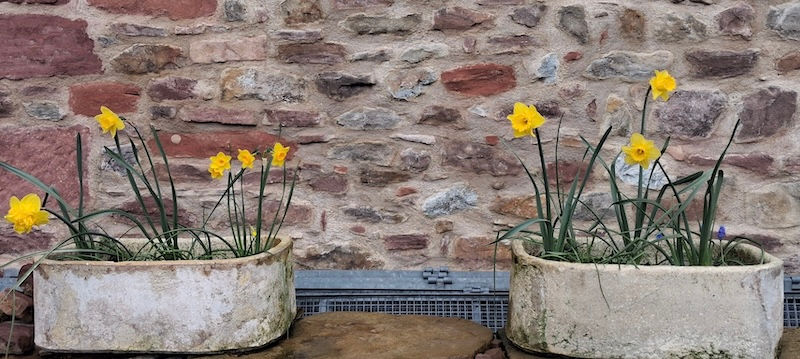
Over the last ten years, at Shandon Farm and around Appletree Cottage, we have planted in excess of a thousand bulbs, using several different varieties and in many different ground conditions. Some in rich loam, whilst less fortunate bulbs ended up in less fertile areas. Nearly all have survived thanks to the flower’s tenacity and tolerance of variable conditions.
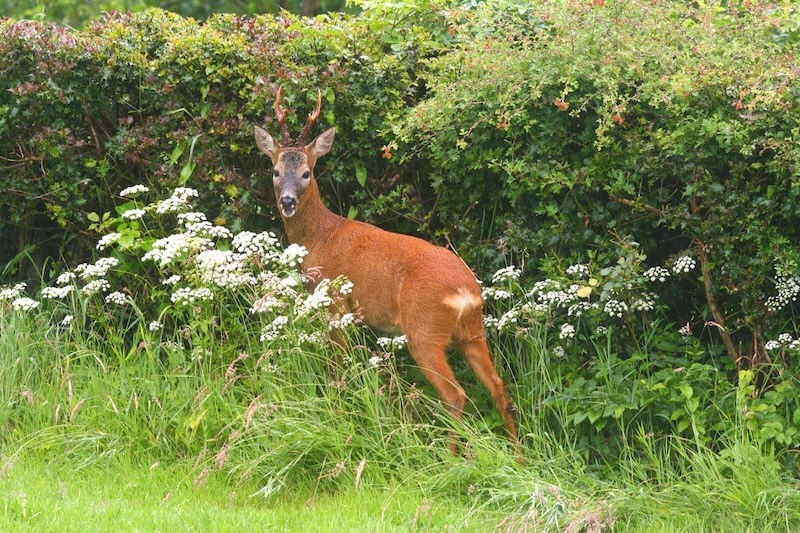
We have read that daffodils are poisonous to deer, and fortunately, the deer seem to have the same information. The wild animals will happily try their luck eating tulips and many shrubs. We have to fence the apple orchard on the farm to prevent the deer from eating the bark from the trees. But they never touch the daffodils. So, a great reason for planting them.

Another benefit of the daffodil is that it is said to deter voles. This is very useful in the orchard as voles like eating the tender roots of young apple trees. Another method we employ to prevent vole activity is to place the tree in a tube when planting and to drive the tube several inches into the ground.
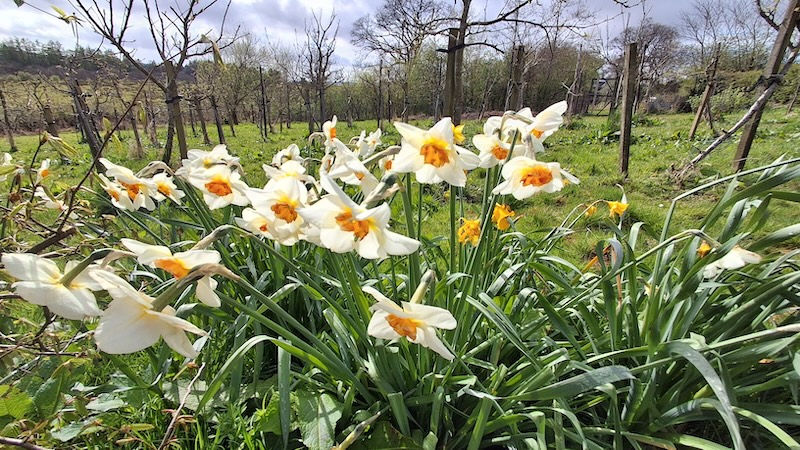
The great thing about planting different varieties of daffodil is that they mature and flower at different times. While some of the flowers have already lost their petals and turned brown, others will still be at the budding stage. This ensures that there will be attractive blooms thriving over several weeks of spring.
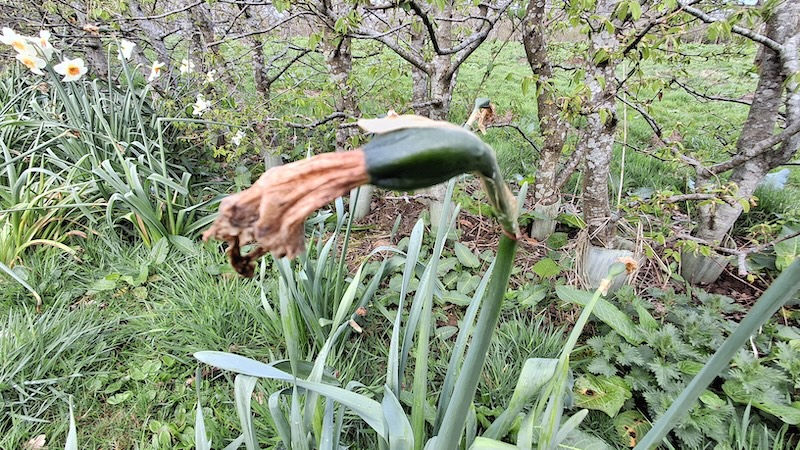
Daffodils are perennial. Once a daffodil has lost its flower, it is important not to cut the foliage down to the ground, either by hand or by mowing. The nutrients need to travel back down the stem into the bulb to nourish next year’s display. The bulbs can survive frost and need not be removed from the ground over winter like some other species.
For us, the daffodils have been a huge success. However, we await discovering some other plants which deer will allow to grow!

A line of daffodils in the orchard 
Apotheose style daffodil 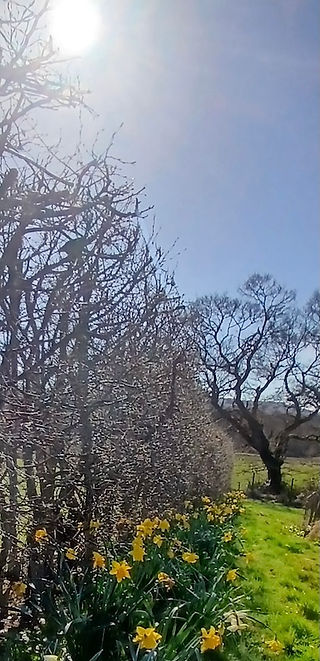
A line of daffodils along the hornbeam headge


